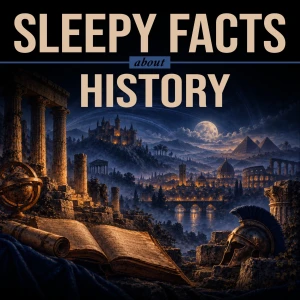
Sleepy Facts About History
sciflix.one - Sleepy History 84 folgen Nov 12, 2026
Sleepy Facts About History is a calm history podcast designed for sleep, relaxation, and quiet curiosity. Each episode explores the human past in a gentle documentary style, covering ancient civilizations, forgotten kingdoms, empires, historical figures, wars, cultural traditions, scientific discoveries, daily life, and major turning points. It avoids loud drama and stressful narration to help listeners stay curious while their minds slow down. The show is produced by the small team at sciflix.one, with episodes written by science fiction author Sascha Schmidt and co-authored by Kyle Smith.
Folgen
What Did Lay Donors Receive in Return for Feeding the Sangha? - Individual Poverty and Collective Wealth in Early Buddhism | Sleepy Facts About History
Got something to say to this podcast? Send a voicemail, and you might hear yourself on the next episode!The image of early Buddhist monks walking silently through a village with their alms bowls is universally recognizable, but the mechanics behind that simple act are often misunderstood. This episode explores how a community of people who had formally renounced society continued to eat, live, and
What Was Daily Life Like Inside the Athenian Household? - Daily Survival and Enslaved Labor in Ancient Athens | Sleepy Facts About History
Got something to say to this podcast? Send a voicemail, and you might hear yourself on the next episode!The democracy of classical Athens is remembered for its citizen assemblies, philosophical debates, and marble monuments. But before any citizen rose to speak on the Pnyx, someone had already carried heavy jars of water from public fountains, coaxed dying embers into a fire, and spent hours grind
How Did the Nabataeans Tame the Flash Floods of the Siq? - The Hydraulic Engineering Behind Petra | Sleepy Facts About History
Got something to say to this podcast? Send a voicemail, and you might hear yourself on the next episode!The ancient city of Petra is famous for its breathtaking rock-cut façades, but its true achievement lies hidden in the landscape. In an arid environment defined by prolonged drought and sudden, violent flash floods, building a major urban center required more than architectural ambition. It dema
How Did the Judeans Survive the Babylonian Exile? - The Material Reality of the Babylonian Deportations | Sleepy Facts About History
Got something to say to this podcast? Send a voicemail, and you might hear yourself on the next episode!In 586 BCE, Babylonian forces broke through the walls of Jerusalem, destroyed the Temple, and marched portions of the population into exile. But the common memory of this event often obscures the historical reality. The Babylonian Exile did not empty the land of Judah, nor did it instantly creat
Why Did a Chinese Monk Walk to India for Buddhist Texts? - Separating the Real Xuanzang from the Legend of Tripitaka | Sleepy Facts About History
Got something to say to this podcast? Send a voicemail, and you might hear yourself on the next episode!Most people who have heard of the monk Xuanzang know him as the timid character Tripitaka from the classic Chinese novel Journey to the West, accompanied by a magical monkey king and fighting demons. But the historical Xuanzang was a rigorous scholar who traveled from Tang China to India in the
What Did It Take to Move Silk Production Beyond China? - How Sericulture Crossed Mountains and Deserts | Sleepy Facts About History
Got something to say to this podcast? Send a voicemail, and you might hear yourself on the next episode!The history of silk is usually remembered as a tale of espionage—a single hidden formula guarded by China until clever monks smuggled silkworm eggs to the Byzantine emperor Justinian in hollow walking sticks. This satisfying narrative of a stolen secret overlooks a much more complex reality. Sil
Who Built the Underground Aqueducts of Peru? - The Hidden Water Galleries of the Nazca Coast | Sleepy Facts About History
Got something to say to this podcast? Send a voicemail, and you might hear yourself on the next episode!In one of the driest landscapes on Earth, the rivers that descend from the Andes vanish into the sand long before reaching the sea. Yet for centuries, communities in the Nazca desert of southern Peru sustained complex societies and productive agriculture. The secret to their survival lies not in
How Did Ancient Teotihuacan Function Beyond Its Famous Pyramids? - The Residential Grid of Teotihuacan | Sleepy Facts About History
Got something to say to this podcast? Send a voicemail, and you might hear yourself on the next episode!When we picture the ancient site of Teotihuacan, we usually envision the towering Pyramid of the Sun and the sweeping Avenue of the Dead. But between those great monuments lay a vast residential grid where up to a hundred thousand people actually lived, worked, and worshipped. This episode explo
What Is the Anishinaabe Migration Tradition? - The Council of Three Fires and the Great Lakes Water-World | Sleepy Facts About History
Got something to say to this podcast? Send a voicemail, and you might hear yourself on the next episode!The Anishinaabe migration tradition is often misunderstood as either a vague legend or a simple route description that can be traced on a modern map. It is actually a detailed framework for understanding how the Ojibwe, Odawa, and Potawatomi peoples moved across the Great Lakes region over centu
How Did Polynesians Navigate the Pacific Without Instruments? - The Modern Revival of Polynesian Voyaging | Sleepy Facts About History
Got something to say to this podcast? Send a voicemail, and you might hear yourself on the next episode!The Pacific Ocean covers roughly one-third of the Earth's surface, and the islands scattered across it are remarkably small and distant. For generations, a central question has lingered: how did human beings find and settle these isolated specks of land without compasses, sextants, or paper maps
What Was the Gaya Confederacy in Ancient Korea? - The Rise and Fall of the Gaya Polities | Sleepy Facts About History
Got something to say to this podcast? Send a voicemail, and you might hear yourself on the next episode!The history of ancient Korea is usually told through the familiar framework of the Three Kingdoms: Goguryeo, Baekje, and Silla. Yet for centuries, a different kind of political world operated alongside them. This episode explores the Gaya confederacy, a decentralized network of polities clustere
What Made the Bagan Temples Outlast Their Dynasty? - The Buddhist Merit Economy of Pagan | Sleepy Facts About History
Got something to say to this podcast? Send a voicemail, and you might hear yourself on the next episode!In one of the driest regions of Asia, a medieval kingdom learned to capture monsoon water in an extensive network of weirs and canals. Yet the agricultural surplus generated by this hydraulic infrastructure was not channeled into armies or royal treasuries. Instead, it flowed into a religious ec
How Did the Asante Defend the Golden Stool from British Conquest? - The War of the Golden Stool and the Limits of Colonial Power | Sleepy Facts About History
Got something to say to this podcast? Send a voicemail, and you might hear yourself on the next episode!In early 1900, a British colonial governor arrived in Kumasi and demanded to sit upon the Golden Stool of the Asante Empire. Governor Frederick Hodgson believed this golden object was simply a throne, a physical seat of sovereignty that could be occupied by a conqueror to symbolize the transfer
How Did an Army of Llaneros and Mercenaries Liberate Northern South America? - The Short-Lived Republic of Gran Colombia | Sleepy Facts About History
Got something to say to this podcast? Send a voicemail, and you might hear yourself on the next episode!In 1819, an army of llanero horsemen, British mercenaries, and Andean recruits crossed flooded plains and frozen mountain passes to secure independence from Spain. The republic they created, Gran Colombia, was meant to unite northern South America under a single central government. Yet it dissol
Was the Model Parliament Actually Democratic? - Corporate Representation and the 1295 Parliament | Sleepy Facts About History
Got something to say to this podcast? Send a voicemail, and you might hear yourself on the next episode!When we picture the English Parliament today, we imagine elected officials, legislative debates, and a system built on popular representation. But the assembly King Edward I summoned to Westminster in November 1295 looked nothing like this. There was no permanent chamber, no universal suffrage,
How Did a Lame-Duck Congress Try to Resist Thomas Jefferson? - The Constitutional Crisis of the 1800 Presidential Election | Sleepy Facts About History
Got something to say to this podcast? Send a voicemail, and you might hear yourself on the next episode!In the winter of 1800 and 1801, the United States government nearly came apart over a tied presidential election that the Constitution had not anticipated. Thomas Jefferson and Aaron Burr each received seventy-three electoral votes, sending the decision to a lame-duck House of Representatives co
What Happened When Colonized Peoples Petitioned the United Nations? - The UN Petition Mechanism and the Struggle for Namibia | Sleepy Facts About History
Got something to say to this podcast? Send a voicemail, and you might hear yourself on the next episode!In 1945, European empires still treated their overseas territories as domestic possessions, handling petitions from colonized peoples as routine internal administrative matters. Within a few years, those same grievances could land on a desk in a fluorescent-lit committee room in New York, forcin
What Did the Berlin Airlift Reveal About the Early Cold War? - The Berlin Airlift and the Logistics of the Early Cold War | Sleepy Facts About History
Got something to say to this podcast? Send a voicemail, and you might hear yourself on the next episode!In the summer of 1948, the western powers began supplying a city of two million people entirely by air. Every road, rail, and canal link to West Berlin had been severed by the Soviets, leaving only three narrow air corridors twenty miles wide. For fifteen months, coal, flour, dried milk, and win
How Did Nazi Propaganda Narrow the Imaginable World? - The 1937 Degenerate Art Exhibition and the Mechanics of Public Compliance | Sleepy Facts About History
Got something to say to this podcast? Send a voicemail, and you might hear yourself on the next episode!Most of us think we already know what propaganda is: a government tells a lie, repeats it often enough, and people believe it because they have no way to hear anything else. But this picture misses almost everything that makes propaganda actually work as a system. This episode examines the machi
Were Ashoka's Public Inscriptions Governance or Propaganda? - Ashoka's Edicts and the Public Voice of Empire | Sleepy Facts About History
Got something to say to this podcast? Send a voicemail, and you might hear yourself on the next episode!How does a ruler make himself present to people who will never see him, and what happens when a state publicly commits itself to standards it cannot guarantee? In the third century BCE, Emperor Ashoka governed a vast realm stretching from Afghanistan to Bengal. Most of his subjects would never h
How Did the Classroom Become a Machine for National Identity? - Building the Nation in the Nineteenth-Century Classroom | Sleepy Facts About History
Got something to say to this podcast? Send a voicemail, and you might hear yourself on the next episode!Before the nineteenth century, a child in rural France, Prussia, or Japan would likely have known their local village, dialect, and regional saints far better than any national borders or standardized tongue. The idea that every child should spend years in a state-directed classroom learning to
How Did a Dutch Fleet Reshape the British Monarchy? - The Negotiated Transfer of Power in 1688 | Sleepy Facts About History
Got something to say to this podcast? Send a voicemail, and you might hear yourself on the next episode!In the summer of 1688, English Protestants looked at their Catholic king, James II, and feared he was building an absolutist state modeled on France. Within months, seven English nobles invited a foreign prince to bring an army to English soil. The resulting Dutch invasion and the subsequent pol
How Did the Last Pharaoh Use Statecraft to Defend Egypt? - Cleopatra VII and the Statecraft Behind the Scandal | Sleepy Facts About History
Got something to say to this podcast? Send a voicemail, and you might hear yourself on the next episode!For two thousand years, the prevailing image of Cleopatra has been shaped by the man who defeated her. She is widely remembered as a seductress and a romantic heroine, but this familiar figure is largely the invention of Octavian's political propaganda. This episode examines the vast gap between
How Did Occupied Poland Become the Laboratory of Nazi Racial Empire? - The 1939 Partition and the Nazi Occupation Apparatus | Sleepy Facts About History
Got something to say to this podcast? Send a voicemail, and you might hear yourself on the next episode!In September 1939, Poland vanished from the map, divided between German and Soviet forces. But what followed was not a conventional military occupation. It was the immediate opening of a racial war, conducted with bureaucratic precision in some regions and ruthless improvisation in others. This
Why Did the German Offensive Fail at the First Battle of Ypres? - The Race to the Sea and the End of the Mobile War | Sleepy Facts About History
Got something to say to this podcast? Send a voicemail, and you might hear yourself on the next episode!The mobile war of 1914 did not end with a single decisive battle, but through a cumulative process of failed flanking attempts often misnamed the Race to the Sea. This episode examines how French and German forces repeatedly tried to outflank each other through Picardy and Flanders, extending th
Why Did Enslaved People Fail to Join John Brown's Rebellion? - The Harpers Ferry Raid and the Terror of Slave Rebellion | Sleepy Facts About History
Got something to say to this podcast? Send a voicemail, and you might hear yourself on the next episode!In October 1859, an aging white abolitionist named John Brown led a small, interracial band of men into the Virginia town of Harpers Ferry. Their goal was to seize the federal armory, distribute weapons to enslaved people, and spark a guerrilla campaign against slavery. The plan failed almost im
How Did French Infantry Squares Defeat the Mamluk Cavalry? - Napoleon's Egyptian Expedition and the Failure of Occupation | Sleepy Facts About History
Got something to say to this podcast? Send a voicemail, and you might hear yourself on the next episode!In July 1798, a French army landed in Egypt, defeated a Mamluk-led force near Cairo, and discovered that winning a battle is not the same as governing a society. The clash often remembered as the Battle of the Pyramids actually took place on the irrigated floodplain of the Nile near the village
Why Did Armies Adopt the Arquebus When Early Firearms Were So Flawed? - The Organizational Logic of the Arquebus | Sleepy Facts About History
Got something to say to this podcast? Send a voicemail, and you might hear yourself on the next episode!The early hand cannon was a deeply impractical object, often requiring two men and three hands to aim, hold, and ignite. Yet from this awkward beginning emerged the arquebus, a weapon that fundamentally changed the shape of European warfare. This episode explores how the mechanical breakthrough
What Happened When the Crusaders Were Denied the Plunder of Nicaea? - The First Crusade and the Fall of Nicaea | Sleepy Facts About History
Got something to say to this podcast? Send a voicemail, and you might hear yourself on the next episode!In the spring of 1097, a coalition of Western European princes laid siege to Nicaea, the Seljuk capital barely a hundred miles from Constantinople. The city’s formidable land walls and the broad expanse of Lake Askania made it seem impregnable to a traditional land assault. To force the city’s s
How Did the Assyrian Empire Breach the Walls of Lachish? - Evidence and Propaganda in Sennacherib’s Levant Campaign | Sleepy Facts About History
Got something to say to this podcast? Send a voicemail, and you might hear yourself on the next episode!In 701 BCE, the Assyrian army arrived at the fortified Judean city of Lachish, building a massive stone and earth ramp against its walls. The assault that followed is one of the most completely documented sieges in the ancient world. By reading three very different kinds of evidence together—the
Was the Revolt of the Three Feudatories an Ethnic War? - The Revolt of the Three Feudatories | Sleepy Facts About History
Got something to say to this podcast? Send a voicemail, and you might hear yourself on the next episode!In 1644, the Ming general Wu Sangui opened the gates at Shanhai Pass, allowing Manchu armies to sweep into China and establish the Qing dynasty. Nearly thirty years later, that same general launched a devastating rebellion against the empire he had helped create. This episode explores the Revolt
How Did a Russian Serf Estate Actually Work? - Life and Labor on a Sheremetev Estate | Sleepy Facts About History
Got something to say to this podcast? Send a voicemail, and you might hear yourself on the next episode!Between a birch forest and a spring-flooded river, two hundred households arranged their lives around a bell that marked work and prayer. They were serfs, bound to the land and a landlord by laws that had hardened over two centuries. But understanding their world means looking past the simple la
What Was the Real Role of Gorée Island in the Atlantic Slave Trade? - Gorée Island and the Memory of the Atlantic Slave Trade | Sleepy Facts About History
Got something to say to this podcast? Send a voicemail, and you might hear yourself on the next episode!The pink-walled House of Slaves on Gorée Island, with its narrow doorway opening onto the Atlantic, is one of the most recognized images of the Atlantic slave trade. Millions of people are believed to have passed through this Door of No Return into the Middle Passage. Yet the historical records
Was the British Slave Trade a Legally Protected Industry? - From Royal Monopoly to Private Enterprise in the Atlantic Slave Trade | Sleepy Facts About History
Got something to say to this podcast? Send a voicemail, and you might hear yourself on the next episode!The familiar image of the Atlantic slave trade often involves a simple triangle on a school map or lawless vessels operating at the margins of respectable society. The reality of eighteenth-century British commerce was entirely different. The slave trade was a chartered, insured, and legally pro
How Did the Portuguese Slave Trade Begin? - The Shift From Maritime Raiding to Commercial Slave Trading in West Africa | Sleepy Facts About History
Got something to say to this podcast? Send a voicemail, and you might hear yourself on the next episode!In the summer of 1444, two hundred and thirty-five captive Africans were paraded through a Portuguese port town before Prince Henry. This public event in Lagos marked a crucial turning point, establishing a model for an organized, state-sanctioned trafficking system that would eventually grow in
How Did the Ottoman Janissaries Become Kingmakers? - The Political Evolution of the Janissary Corps | Sleepy Facts About History
Got something to say to this podcast? Send a voicemail, and you might hear yourself on the next episode!The Janissaries began as an elite infantry force, paid in cash, housed in barracks, and bound directly to the Ottoman sultan. Over five centuries, they evolved into something far more complex. This episode examines how the Janissary corps transformed from a standing army into a powerful corporat
What Happened Between the Xiongnu and the Huns? - The Historical Puzzle of the Xiongnu and the Huns | Sleepy Facts About History
Got something to say to this podcast? Send a voicemail, and you might hear yourself on the next episode!In the late second century, the Xiongnu confederation that had challenged Han China fragmented and faded from the historical record. Roughly two centuries later, a terrifying people called the Huns appeared on the Roman Danube frontier. This episode explores the persistent historical question of
Why Did Paperwork Matter After a Samurai Battle? - The Household System of Kamakura Warfare | Sleepy Facts About History
Got something to say to this podcast? Send a voicemail, and you might hear yourself on the next episode!The familiar image of the samurai is a lone swordsman testing his personal honor in a face-to-face duel. But the warriors of the Kamakura period, from 1185 to 1333, looked and fought very differently. At the center of this episode is the mounted archer in his great ō-yoroi armor, shooting from h
How Did an Enslaved Man Lead the Delhi Sultanate's Armies? - Malik Kafur and the Delhi Sultanate's Raids into the Deccan | Sleepy Facts About History
Got something to say to this podcast? Send a voicemail, and you might hear yourself on the next episode!In 1307, an enslaved man captured in battle eight years earlier led thousands of cavalry south from Delhi toward kingdoms no northern sultan had ever reached. His name was Malik Kafur, and the campaigns he commanded into the Deccan would reshape how we understand what premodern empires could act
Was There a University in Timbuktu? - The Manuscript Culture of Timbuktu | Sleepy Facts About History
Got something to say to this podcast? Send a voicemail, and you might hear yourself on the next episode!Timbuktu is often imagined as a mythical city of gold, but its true historical significance lies in something far more durable. This episode explores how a settlement on the southern edge of the Sahara, lacking its own gold mines or salt deposits, became one of the most important centers of lear
Why Did the First Islamic Civil War Fracture the Muslim Community? - The First Fitna and the Crisis of Early Islamic Authority | Sleepy Facts About History
Got something to say to this podcast? Send a voicemail, and you might hear yourself on the next episode!In the year 656, an elderly man reading the Quran in his home in Medina was murdered by rebels, and the blood that stained the sacred pages marked a permanent fracture in the early Muslim community. The man was Uthman ibn Affan, the third caliph, and his death shattered the assumption that the l
Why Did the First Dome of Hagia Sophia Collapse? - The Imperial Wager Behind Hagia Sophia | Sleepy Facts About History
Got something to say to this podcast? Send a voicemail, and you might hear yourself on the next episode!In January of 532, the center of Constantinople burned during the Nika riots, leaving the old church of Hagia Sophia in ruins. The emperor Justinian responded by ordering an unprecedented reconstruction project, tasking two theorists of geometry and mechanics, Anthemius of Tralles and Isidore of
How Did Paying Tribute Build the English State? - Silver, Oaths, and the Viking Threat | Sleepy Facts About History
Got something to say to this podcast? Send a voicemail, and you might hear yourself on the next episode!When Scandinavian raiders arrived on the coasts of early medieval Europe, kings often faced an impossible choice: risk destruction in battle or buy off the attackers with vast quantities of silver. This episode explores the practice often remembered as Danegeld, examining it not as a simple sign
How Did the Carolingian System Enforce Royal Authority? - Charlemagne's Mobile Court | Sleepy Facts About History
Got something to say to this podcast? Send a voicemail, and you might hear yourself on the next episode!We generally assume that governing a large empire requires a fixed capital, a standing bureaucracy, and a ruler who stays put. Charlemagne, who ruled the Franks from 768 to 814, had none of these. His government was a mobile court—several hundred people, animals, and carts—that moved constantly
What Did It Take to Cast Bronze in Ancient China? - Anyang Foundries and the Architecture of Shang Power | Sleepy Facts About History
Got something to say to this podcast? Send a voicemail, and you might hear yourself on the next episode!Three thousand years ago in the Shang capital at Anyang, craftspeople broke open fired clay molds to reveal heavy bronze vessels destined for ancestral rituals. Creating these objects was not a matter of mysterious lost wisdom, but the result of an extraordinarily complex manufacturing process.
How Did Indus Goods Reach Mesopotamia? - Segmented Trade in the Bronze Age World | Sleepy Facts About History
Got something to say to this podcast? Send a voicemail, and you might hear yourself on the next episode!A single etched carnelian bead, weighing almost nothing and found in Mesopotamia, offers physical proof that it traveled four thousand miles from the Indus Valley. Yet this small, polished object proves a connection between two distant civilizations without proving that any one person made the e
What Was the True Speed of the Persian Royal Couriers? - The Logistics of the Achaemenid Relay Network | Sleepy Facts About History
Got something to say to this podcast? Send a voicemail, and you might hear yourself on the next episode!The Achaemenid Empire, forged by Cyrus the Great, stretched from the Indus Valley to the Aegean, covering thousands of kilometers of rugged and diverse terrain. Keeping this massive territorial state together required more than military might; it demanded a way to move information quickly across
How Did Roman Women Own Property and Wield Influence Under Male Authority? - The Legal Mechanisms of Roman Women's Autonomy | Sleepy Facts About History
Got something to say to this podcast? Send a voicemail, and you might hear yourself on the next episode!A Roman woman standing before a magistrate to claim an inheritance needed her guardian's seal pressed into the wax beside her own. This simple requirement captures the central puzzle of Roman women's lives. They operated within a legal system that made male authority the formal language of power
How Did a Consonant Script Become the Greek Alphabet? - The Invention of the Vowel | Sleepy Facts About History
Got something to say to this podcast? Send a voicemail, and you might hear yourself on the next episode!The letter A began as an ox's head. Not as a metaphor, but as a Phoenician pictograph turned sideways, representing a consonant sound that Greek speakers did not use. When the Greeks encountered this maritime trading script, they did something remarkable: they kept the shapes but changed the fun
What Do Ancient Clay Exercise Tablets Reveal About Scribal Training? - Learning to Be a Scribe in Ancient Mesopotamia | Sleepy Facts About History
Got something to say to this podcast? Send a voicemail, and you might hear yourself on the next episode!When a student in ancient Mesopotamia pressed a reed stylus into wet clay four thousand years ago, the mark was often too shallow, too deep, or misaligned. Yet that failed wedge survives today as an honest record of what it actually cost to learn to preserve a civilization's memory. This episode
How Did Ancient Egyptian Scribes Read Without Vowels? - Beyond the Temple Walls: The Working Language of Hieroglyphs | Sleepy Facts About History
Got something to say to this podcast? Send a voicemail, and you might hear yourself on the next episode!For centuries, visitors to Egyptian temples have looked at carved rows of owls, eyes, and sun disks and assumed they were gazing at mystical symbols or sacred codes. This episode sets that assumption aside to explore how hieroglyphs actually functioned as a precise, flexible technology for recor
How Did a Secret Network Overthrow the Umayyad Caliphate? - Abu Muslim and the Black Banners of 747 | Sleepy Facts About History
Got something to say to this podcast? Send a voicemail, and you might hear yourself on the next episode!In the mid-740s, travelers carrying scraps of paper, memorized phrases, and collected coins moved through the roads of northeastern Iran. They entered rooms where men swore secret oaths of allegiance to someone they called only the acceptable one from the House of the Prophet. This was the da'wa
What Really Happened During the Trưng Sisters' Rebellion? - Trưng Trắc, Trưng Nhị, and the Han Dynasty Frontier | Sleepy Facts About History
Got something to say to this podcast? Send a voicemail, and you might hear yourself on the next episode!Most people who have heard of the Trưng Sisters picture them as armored figures riding elephants into battle against foreign domination. But the actual historical events of 40 to 43 CE were briefer, more fragile, and far less documented than the modern statues suggest. This episode separates the
Why Did Underground Water Systems Require a Communal Social Contract? - Hand-Dug Water Tunnels of the Ancient World | Sleepy Facts About History
Got something to say to this podcast? Send a voicemail, and you might hear yourself on the next episode!Looking out over an arid plain, a line of crater-like mounds stretching toward the horizon might look like the aftermath of an artillery strike. In reality, these rings of excavated earth are the surface traces of a qanat: a precisely engineered, hand-dug underground tunnel designed to deliver g
Did Greek Physicians Really Dissect Living Criminals in Ptolemaic Egypt? - Herophilus, Erasistratus, and the First Human Dissections | Sleepy Facts About History
Got something to say to this podcast? Send a voicemail, and you might hear yourself on the next episode!In the early third century BCE, the Greek physicians Herophilus and Erasistratus began opening human bodies in Alexandria, distinguishing nerves from tendons, tracing the brain's connections, and naming anatomical structures in ways no one in their tradition had done before. Yet their methods an
How Did the First Coins Change Trust in Ancient Money? - The Invention of Coinage in Ancient Lydia | Sleepy Facts About History
Got something to say to this podcast? Send a voicemail, and you might hear yourself on the next episode!Before coins existed, ancient economies relied on weighed pieces of precious metal to conduct business. This system required merchants, soldiers, and ordinary people to carry scales and touchstones to verify the weight and purity of every lump of silver or gold in every transaction. The inventio
Why Did Ancient Indian Priests Memorize Thousands of Ritual Verses? - The Operative Power of Vedic Sacrifice | Sleepy Facts About History
Got something to say to this podcast? Send a voicemail, and you might hear yourself on the next episode!On the plains of ancient India, men once measured rectangles of earth with cords, stacked specific woods, and kindled fires they believed sustained the cosmos itself. This episode explores the Vedic sacrifice, or yajña, an intricate system of ritual action performed without temples, images, or c
What Do Ceramic Pots Reveal About Daily Life in the Shang Dynasty? - Daily Life and Ancestor Veneration in Late Shang Households | Sleepy Facts About History
Got something to say to this podcast? Send a voicemail, and you might hear yourself on the next episode!When we think of the Shang dynasty, we usually picture the magnificent bronze vessels preserved in museum cases or the king reading political fortunes in cracked oracle bones. But this episode begins somewhere much more ordinary: a packed-earth house in the Yellow River valley around 1200 BCE, w
What Was Persepolis Trying to Say? - Persepolis and the Choreography of Empire | Sleepy Facts About History
Got something to say to this podcast? Send a voicemail, and you might hear yourself on the next episode!Persepolis is often mistaken for a conventional capital city, but the monumental complex built by the Achaemenid kings served a very different purpose. This episode explores how Darius I and his successors constructed a ceremonial stage in the highlands of southwestern Iran to make a visual argu
Did Conquered People Become Slaves in the Ancient Near East? - The Bureaucratic Machinery of Assyrian Deportation | Sleepy Facts About History
Got something to say to this podcast? Send a voicemail, and you might hear yourself on the next episode!Between roughly 744 and 609 BCE, the Neo-Assyrian Empire transformed the forced removal of entire populations into a bureaucratically managed technology of rule. This episode examines how the empire moved tens of thousands of households across vast distances, breaking local resistance, supplying
How Did Early Chinese Mapmakers Balance Measurement and Meaning? - The Problem of Inconsistent Maps in the Jin Dynasty | Sleepy Facts About History
Got something to say to this podcast? Send a voicemail, and you might hear yourself on the next episode!In the third century CE, a Chinese official named Pei Xiu confronted an empire's worth of maps that could not agree with one another. The same roads had different distances, and river courses diverged across regional records. His solution was a set of six principles for judging maps by measurabl
Did the Ancient Heavenly Horses Really Sweat Blood? - Logistics and Legend in the Dayuan Campaigns | Sleepy Facts About History
Got something to say to this podcast? Send a voicemail, and you might hear yourself on the next episode!The Han Dynasty under Emperor Wu commanded one of the ancient world's largest agrarian economies and could field armies of hundreds of thousands. Yet, for years, it struggled to produce the one thing its survival demanded: a horse large and durable enough to carry an armored soldier against the
Did the Pharaoh Actually Perform the Temple Rituals? - The Ritual Language of the Pharaohs | Sleepy Facts About History
Got something to say to this podcast? Send a voicemail, and you might hear yourself on the next episode!When we look at temple carvings showing a pharaoh standing alone before a god, we are not seeing a record of daily reality. The king depicted as ageless and all-powerful might actually have been a child, an invalid, or a ruler hemmed in by political factions. The priests who performed the actual
Did the Nazca Lines Really Need to Be Seen From Above? - Walking the Nazca Lines | Sleepy Facts About History
Got something to say to this podcast? Send a voicemail, and you might hear yourself on the next episode!The Nazca Lines are often presented as a puzzle meant for the sky, requiring a bird's-eye view to be understood. This episode explores the ground-level reality of these vast desert markings in southern Peru, explaining how the Nazca culture used simple tools, collective labor, and an intimate kn
Where Are the Kings of Teotihuacan? - Collective Governance in Ancient Mesoamerica | Sleepy Facts About History
Got something to say to this podcast? Send a voicemail, and you might hear yourself on the next episode!Teotihuacan was one of the largest cities in the ancient world, featuring massive pyramids, a precisely engineered urban grid, and a population of over a hundred thousand people. Yet, unlike contemporary Maya cities, its monumental art and architecture completely lack the names, faces, or dynast
Why Did the Wendat Confederacy Collapse in the 1600s? - The Wendat Confederacy and the Great Lakes Trading World | Sleepy Facts About History
Got something to say to this podcast? Send a voicemail, and you might hear yourself on the next episode!In the early 1600s, between Georgian Bay and Lake Simcoe, the Wendat built permanent agricultural towns that were more densely populated than any other Indigenous settlements north of Mexico. Organized through matrilineal clans and confederacy councils, they anchored a vast trading network that
How Did Humans Settle the Empty Pacific Islands? - The Portable Island Economy of the Pacific Voyagers | Sleepy Facts About History
Got something to say to this podcast? Send a voicemail, and you might hear yourself on the next episode!Three thousand years ago, communities standing on the shores of the Bismarck Archipelago faced an unprecedented challenge: crossing hundreds of kilometers of open ocean to reach islands no human had ever seen. They did not merely navigate the empty sea; they carried with them the complete means
Why Did Rigid Lineage Rules Lead to Queens in the Silla Kingdom? - Golpum and the Hereditary Hierarchy of Ancient Korea | Sleepy Facts About History
Got something to say to this podcast? Send a voicemail, and you might hear yourself on the next episode!In the ancient Korean kingdom of Silla, the right to rule was not earned through military conquest or political maneuvering, but inherited through a concept known as bone quality. This rigid hereditary system, known as golpum, dictated a person's entire life based on their lineage, determining e
Why Did Angkor Gradually Decline Instead of Suddenly Collapsing? - Angkor's Hydraulic City and the Khmer Empire | Sleepy Facts About History
Got something to say to this podcast? Send a voicemail, and you might hear yourself on the next episode!The iconic image of Angkor Wat—a vast stone temple rising above a still moat and framed by forest—is one of the most recognizable buildings on Earth. Yet that familiar picture conceals almost everything about what Angkor actually was. The temple was not a solitary monument in the wilderness. It
Could an African State Manufacture Its Own Firearms to Resist France? - Samori Touré and the Moving Empire of West Africa | Sleepy Facts About History
Got something to say to this podcast? Send a voicemail, and you might hear yourself on the next episode!In the late nineteenth century, the upper Niger region of West Africa was not a quiet backwater waiting for European arrival. It was a landscape of ambitious state-builders, trade networks, and military innovation. Among them was a Dyula trader named Samori Touré, who constructed one of the most
How Did a Popular Rebellion End in an Elite Settlement? - The Two Mexican Independences | Sleepy Facts About History
Got something to say to this podcast? Send a voicemail, and you might hear yourself on the next episode!In September 1810, a priest in the small town of Dolores issued a summons that drew thousands of hungry and subordinated people into the streets, sparking a massive popular rebellion. Yet the independence Mexico finally won eleven years later was negotiated by the very elites who had spent those
How Did a Rebel Warlord's Crisis Create the English Parliament? - The Desperate Origins of Representative Government in England | Sleepy Facts About History
Got something to say to this podcast? Send a voicemail, and you might hear yourself on the next episode!In the winter of 1265, a French-born rebel warlord holding a captive king summoned local landowners and townsmen to Westminster. This assembly has often been remembered as a founding moment of English democracy, but the reality is far more complicated and far less idealistic. The parliament was
How Did the Alien and Sedition Acts Test the Young American Republic? - Matthew Lyon and the Criminalization of Dissent | Sleepy Facts About History
Got something to say to this podcast? Send a voicemail, and you might hear yourself on the next episode!In the summer of 1798, a Vermont congressman named Matthew Lyon was sentenced to four months in prison for calling President John Adams greedy and pompous. While this might sound incomprehensible today, it was the reality of the Alien and Sedition Acts, a set of four laws that tested whether the
How Did Japanese Conquest Destroy European Colonial Prestige? - Japan's Unintentional Dismantling of the Asian Colonial Order | Sleepy Facts About History
Got something to say to this podcast? Send a voicemail, and you might hear yourself on the next episode!In 1941, the colonial world of Southeast Asia rested on a belief so complete it had become invisible: that European power was a permanent fact of nature. Within six months, Japanese armies marching on bicycles through jungle the Europeans had deemed impassable would make that belief unrecoverabl
How Did the Marshall Plan Actually Work? - The Financial Architecture of European Recovery | Sleepy Facts About History
Got something to say to this podcast? Send a voicemail, and you might hear yourself on the next episode!In the freezing winter of 1946, the canals of Western Europe froze solid, coal barges sat idle, and governments from Manchester to Milan discovered that reconstruction was impossible for a reason no bombing raid had caused: they had simply run out of dollars. The Marshall Plan is often remembere
Who Paints the Official Portraits of a Leader? - The Bureaucracy of Manufactured Infallibility | Sleepy Facts About History
Got something to say to this podcast? Send a voicemail, and you might hear yourself on the next episode!When we see identical portraits of a ruler hanging in classrooms, factories, and public squares, it is easy to assume we are looking at a spontaneous outpouring of mass affection or the simple vanity of a powerful man. This episode looks behind the visible surface of a personality cult to examin
Did the Twelve Tables Protect Roman Citizens or Preserve Elite Power? - From Priestly Memory to Public Code: The Making of Roman Law | Sleepy Facts About History
Got something to say to this podcast? Send a voicemail, and you might hear yourself on the next episode!In the early fifth century BCE, a Roman farmer who fell behind on a debt could not know precisely when a creditor might seize him, which days the courts would meet, or what ritual words might save his case. The law existed only in the memories of patrician priests and magistrates. This episode e
How Did Print and Dictionaries Create Standard German? - Print Capitalism and Linguistic Codification in the Nineteenth Century | Sleepy Facts About History
Got something to say to this podcast? Send a voicemail, and you might hear yourself on the next episode!In the early nineteenth century, a child opening a school primer in a German village might have found her own hometown's name spelled according to rules devised hundreds of miles away. The words on the page did not match the speech of her parents or her neighbors. This gap between spoken dialect
How Did the English Commonwealth Become a Protectorate? - From Regicide to the Protectorate | Sleepy Facts About History
Got something to say to this podcast? Send a voicemail, and you might hear yourself on the next episode!On January 30, 1649, a king knelt in the winter cold and lost his head. Within months, the English monarchy and the House of Lords were formally abolished, and England was declared a Commonwealth and Free State. Yet the men who destroyed centuries of political order quickly found themselves trap
How Did the First Emperor Standardize a Vast Realm? - The Administrative Machinery of Qin Unification | Sleepy Facts About History
Got something to say to this podcast? Send a voicemail, and you might hear yourself on the next episode!In 221 BCE, the king of Qin faced a problem that military victory had not solved. He had defeated six rival kingdoms, but the conquered territories spoke different dialects, used multiple currencies, and measured goods with entirely different weights. The absence of enemies was not the same as t
Empfohlen

Welt der Physik | Podcast

Puppies and Crime

Apokalypse & Filterkaffee - Presseklub mit Markus Feldenkirchen

SWR Umweltnews

Easy German

tagesschau in 100 Sekunden: Das aktuelle News-Update (Audio)
Hörsaal - Deutschlandfunk Nova
Interpretationssache - Der Musikpodcast

Augstein & Blome

Was tun, Herr General? - Der Podcast zum Ukraine-Krieg

WDR 5 Das philosophische Radio

1001 Nacht
